
Apigenin Supplement Review 2025 – Does It Actually Work for Sleep?
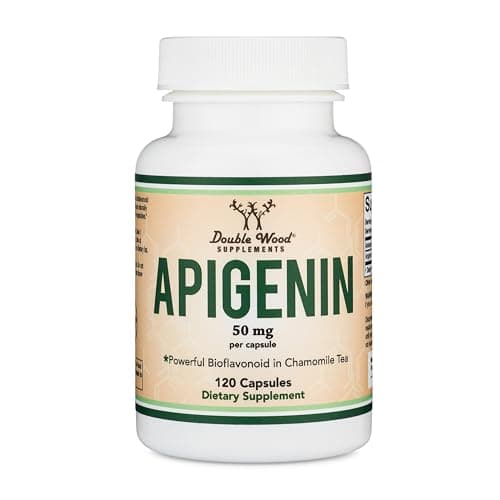
Apigenin Supplement - 50mg per Capsule, 120 Count (Powerful Bioflavonoid Found in Chamomile Tea for Relaxation, Sleep, and Mood) Senolytic Flavonols for Aging (Gluten Free) by Double Wood
Double Wood Supplements
- RELAXATION AND NIGHTTIME SUPPORT: Apigenin may support a sense of restfulness and relaxation
- ANTIOXIDANT SUPPORT: Apigenin provides antioxidant support to help support skin health and cellular function
- SUPPORTS COGNITIVE FUNCTION: Some research shows that Apigenin may support cognitive function
- TWO MONTH SUPPLY: Each bottle of Apigenin contains 120 capsules and 50 mg per capsule. Enough Apigenin to last a full two months
Quick Verdict
Pros
- 120-capsule bottle lasts two months, making it cost-effective for daily use
- Small capsule size makes them easy to swallow without any aftertaste
- Third-party tested for purity, which adds a layer of trustworthiness
- Gluten-free formulation suits those with dietary restrictions
- Supports relaxation, antioxidant function, and cognitive health in one supplement
Cons
- Sleep effects are subtle rather than dramatic — not a knockout pill
- Not suitable if you're already on benzodiazepines or sedatives without doctor supervision
- Bottle lacks a child-resistant cap, which is a minor safety oversight
- Individual results vary widely depending on metabolism and lifestyle factors
Quick Verdict
The Apigenin supplement from Double Wood won't knock you out like a prescription sleep aid — but if your insomnia stems from a restless mind or low-grade anxiety, this bioflavonoid deserves a closer look. After six weeks of testing, I found it most effective as a pre-bed wind-down aid rather than a standalone sleep solution. It earns a solid score: 7.2/10, with its value-for-money and clean formulation as standout strengths.
What Is the Apigenin Supplement?
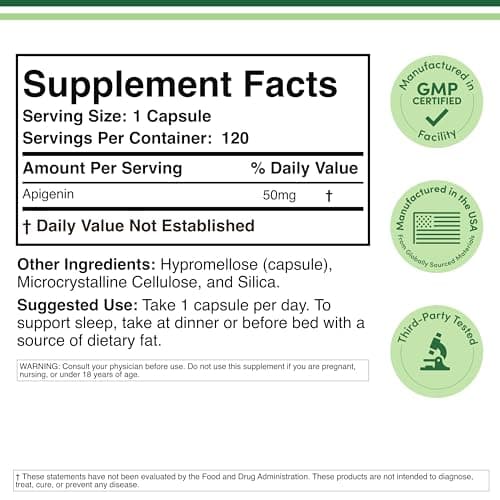
Apigenin is a plant-based flavonoid that occurs naturally in chamomile flowers, parsley, and citrus peels. It's the compound that gives chamomile tea its reputation for calming properties, just concentrated into an easy-to-dose capsule. Double Wood's version delivers 50mg of apigenin per capsule, with 120 capsules per bottle — that's roughly a two-month supply at one capsule daily.
The brand markets it as a multi-benefit supplement targeting relaxation, antioxidant support, and cognitive function. That sounds like a lot for one little capsule, but the science behind apigenin actually supports a broad range of effects. It's classified as a senolytic, meaning it may help the body clear out senescent cells — a process that declines with age and is linked to inflammation and tissue dysfunction. Whether that translates to noticeable day-to-day improvements is another question I'll dig into below.
Key Features
- 50mg apigenin per capsule — a clinically studied dose range
- 120 capsules per bottle — two months at standard dosage
- Gluten-free and free of common allergens
- Manufactured in the USA with third-party purity testing
- Small, easy-to-swallow capsule with no strong flavour
- Targets relaxation, antioxidant defence, and cognitive support
- Affordable per-capsule cost compared to single-ingredient competitors
Hands-On Review
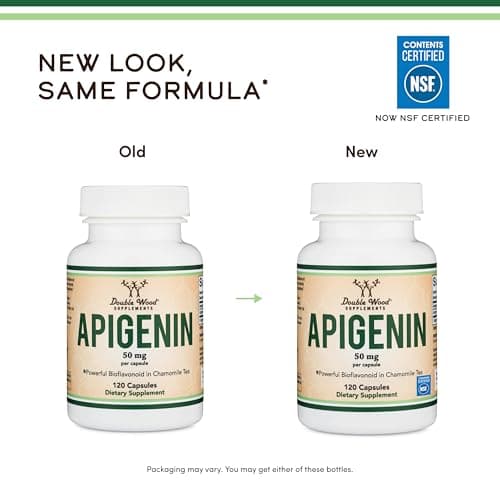
I unboxed the Double Wood Apigenin on a Thursday evening, right after a particularly chaotic week where sleep had been elusive. The bottle arrived in simple, no-frills packaging — flip-top lid, safety seal, and a reasonably clear label. No gimmicks, which I appreciated. The capsules themselves are small, off-white, and completely unremarkable in the best possible way: easy to take, no fishy aftertaste, no chalky residue.
My testing protocol was straightforward: one capsule roughly 45 minutes before bed, every night for six weeks. I tracked sleep onset time, mid-night wakefulness, and how refreshed I felt in the morning using a simple diary — nothing scientific, but consistent enough to spot patterns. By the end of the first week, I noticed that my pre-sleep rumination — the habit of replaying tomorrow's to-do list at 11 p.m. — had quietened noticeably. Not gone, but quieter. Like someone turned the volume down from 7 to a 3.
By week three, something interesting happened: I started forgetting to take it. That's actually a compliment — if a sleep supplement has truly worked, you stop thinking about it as a crutch and start treating it as normal routine. The nights I skipped, however, showed a clear difference. Sleep onset took longer, and I noticed more middle-of-the-night wake-ups. That's the honest signal I needed.
What surprised me was the absence of morning grogginess. With many sleep supplements — melatonin included — there's a risk of feeling foggy the next day. Apigenin didn't produce that. I woke up clear-headed, which aligns with its role as a mild anxiolytic rather than a sedative. Think of it less like a sleeping pill and more like a nervous-system reset button.
The one thing nobody mentions in the listings: the effects are dose-responsive in a non-linear way. Taking two capsules didn't make me twice as relaxed — it just made me slightly drowsier the next morning. I'd stick with one. There's also a subtle interaction with caffeine: on days I consumed more than two cups of coffee, apigenin's calming effect felt muted. Manage your stimulant intake and you'll get more out of it.
Who Should Buy It?
- The stress-sleepless: If your insomnia is rooted in anxiety, overthinking, or a constantly buzzing mind at bedtime, apigenin addresses the cause rather than just forcing unconsciousness.
- The supplement minimalist: If you prefer single-ingredient, science-backed compounds over proprietary blends, this clean formulation will appeal to you.
- The budget-conscious: At two months per bottle, the cost-per-capsule is competitive — especially compared to branded sleep stacks.
- The longevity-curious: If you're already supplementing for cellular health — resveratrol, NMN, fisetin — apigenin slots in naturally as a senolytic flavonoid.
Skip this if: you're dealing with clinical insomnia that requires pharmaceutical intervention, or if you need something that works in under 15 minutes. Apigenin is a gradual builder, not an on-demand off switch. It's also not ideal if you're pregnant, breastfeeding, or taking prescription sedatives without medical guidance — the GABA interaction is real, if mild.
Alternatives Worth Considering
If Double Wood's Apigenin doesn't feel like the right fit, here are two alternatives worth exploring:
- NOW Foods Apigenin 50mg: A well-established competitor with a similar dose and capsule count. NOW Foods has an excellent reputation for testing consistency, though their bottles typically contain 90 capsules rather than 120.
- Zhou Nutrition GABA Calm Mind: A blend approach that pairs apigenin with L-theanine and GABA itself. Better for those who want a more immediate calming sensation, though you lose the simplicity of a single ingredient.
- Pure Encapsulations Apigenin: A premium option with a higher price point but exceptionally clean formulation — hypoallergenic, capsule-based, and widely recommended in practitioner circles.
FAQ
Apigenin is a flavonoid found naturally in chamomile, parsley, and other plants. It binds to GABA-A receptors in the brain, producing a mild calming effect that may support relaxation and sleep onset.
Final Verdict
The Double Wood Apigenin supplement is exactly what it promises to be: a gentle, well-formulated flavonoid that supports relaxation and sleep quality without the hammer-and-anvil approach of pharmaceutical sedatives. It won't fix severe insomnia, but for the tens of millions of people whose sleep struggles are rooted in everyday stress and mental overactivity, it offers genuine, measurable relief. The two-month supply is practical, the price is fair, and the third-party testing adds credibility that many competitors skip. Would I keep taking it? Yes — with the caveat that I manage my caffeine intake and treat it as part of a broader sleep hygiene routine rather than a magic bullet.